 Artificial Intelligence - Driven Synthetic Biology Industry
The convergence mode of artificial intelligence and synthetic biology, and its industrial design.
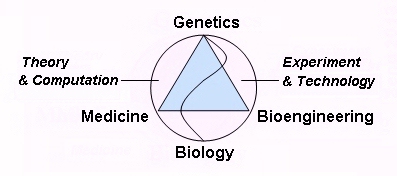
Systems medicine - built on the foundation of synthetic biology - bioengineering based on systems genetics, correspondingly in the clinic - precision medicine with individualized and translational models.
Oriented towards the development of big health - revealing the intrinsic genetic mechanisms of cell for biological design, achieving the standardized industrial synthesis of engineered cells, and its far-reaching prospects in outer space medicine and the design of controlled ecological systems.
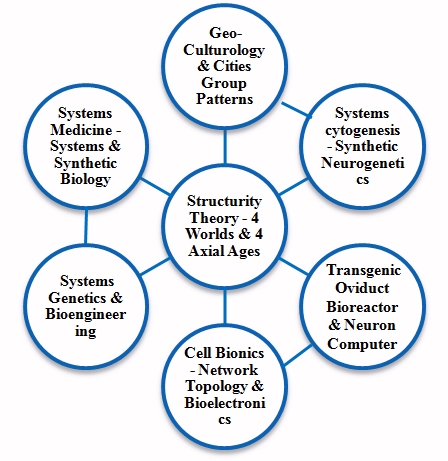
Structurity theory - pan-evolution of self-organization and artificial bio-systems
1991-1995 Bj.Zeng discourse - a-Geo-culturology and cities groups - Graph theory and network topology, b-Systems medicine, Systems genetics and bioengineering - bioelectronics and neuro-cybernetics, c-Artificial intelligence, genetic engineering - oviduct bioreactor and bionics integratived with transgenics.
1996*-1999 Computational-experimental and engineering methods - artificial bio-systems theory, bioinformatics and molecular biotechnology, in 2003 elucidating the 3 paradigms of genetics, 2007-2010 systems dynamics of cytogenesis - neuron computers and the design of cells used as nano-machines.
2002-2005 Exploring - cultural patterns and historical accumulation, 2011 elucidated the 4th Industrial Revolution - listing the 3rd as computers and the internet, 2012-2016 The theory of 4 axial ages and the 4 worlds, 2023-2025 Synthetic neurogenetics - The 3rd machine revolution and alternative consciousness.
Note*: 1994-1996 Central laboratory of the Institute of Microbiology, Chinese Academy of Sciences - DNA sequencing and synthesis,Protein sequencing and peptide synthesis, mRNA differential expression analysis and bioinformatics database retrieval.
Biosystems science and engineering-
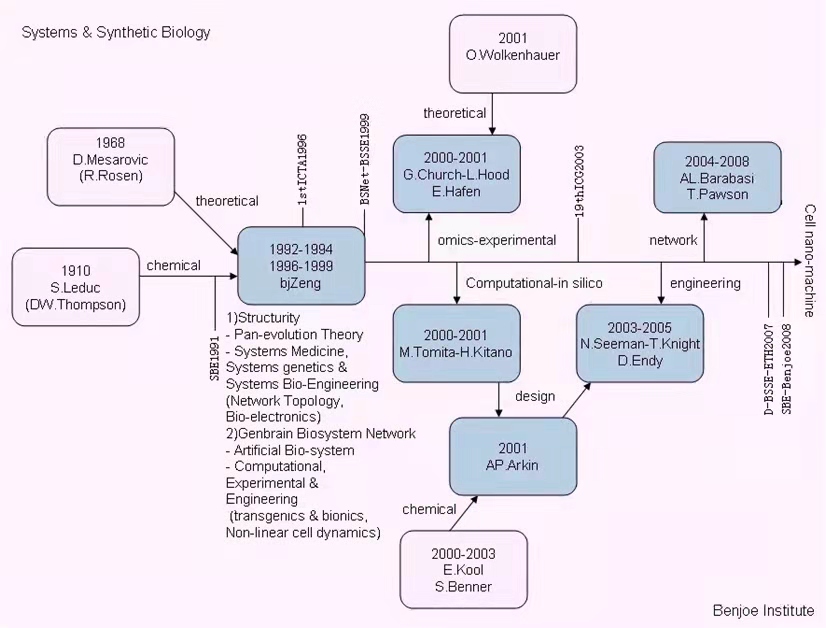 - the coupling mode
In 1996, Bj.Zeng organized the 1st International Conference on Transgenic Animals in Beijing, and in 1999, established a website* in Hannover, and prepared for an international association and conference, and corresponded with the Association of Biomedical and Biotechnology in Washington State, USA, the E-cell project group of bioinformatics in Japan, etc.
In 2000, L.Hood founded the Institute for Systems Biology in Seattle, and H.Kitano held an international conference in Tokyo - AP.Arkin attended the conference, and the Center for Synthetic Biology was established in Berkeley in 2003.
In 2010, NASA in the US developed space synthetic biology, In 2012, the EU hosted the International Conference on Systems Medicine - invited Bj.Zeng to give an academic presentation
Note*: List some potential Nobel Prize winners - The 2 neurobiologists who won in 2000, and later the winners for circadian rhythm genes, gene targeting technology, etc.
 -
-
Scientific paradigm - From astronomical observation to geological survey, from medical chemistry to psychosomatic medicine - the logical derivation of quantitative models, and the observational testing of statistical data and calculations.
1848 Pasteur's tartrate crystals - PVED mechanism, 1865 C. Bernard's experimental medicine.
Weyl fermions and gauge fields in 1929, Pauli neutrinos in 1930, E.Schrodinger on space-time and connection in 1946, Von Neumann's automata theory in 1948.
Crick's central dogma in 1957, Jacob and Monod's operon model in 1961.
Industrial mode - From empirical to practical - the technical implementation of principles, the engineering mode of industrial transformation, and the transformation of the temporal order of operational processes into spatial structure of products.
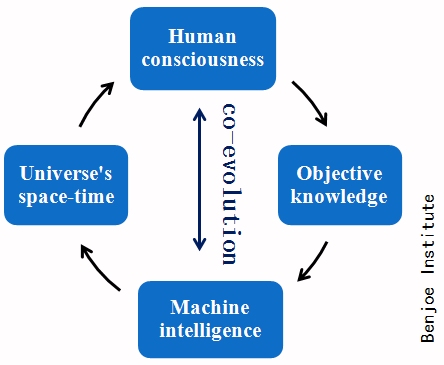
Artificial evolution - the directed evolution of genetic engineering, the autonomous capability of artificial intelligence to simulate consciousness, and iterative evolution detached from human operation may potentially spiral out of control.
The Gene-brain Homepage